

Airport terminal capacity is constantly affected by changes in infrastructure, passenger demand, and operational requirements. Construction projects, redesigned passenger routes, additional checkpoints, and regulatory changes can alter how passengers move through the terminal and where congestion may occur. Before implementing these changes, airport planners need to evaluate their impact on passenger flows, processing capacity, and terminal performance.
With AMORPH.aero Planning Studio, airport planners, terminal designers, and master planning teams can simulate alternative layouts and operational scenarios, assess capacity constraints during peak traffic periods, and compare potential changes before implementation.
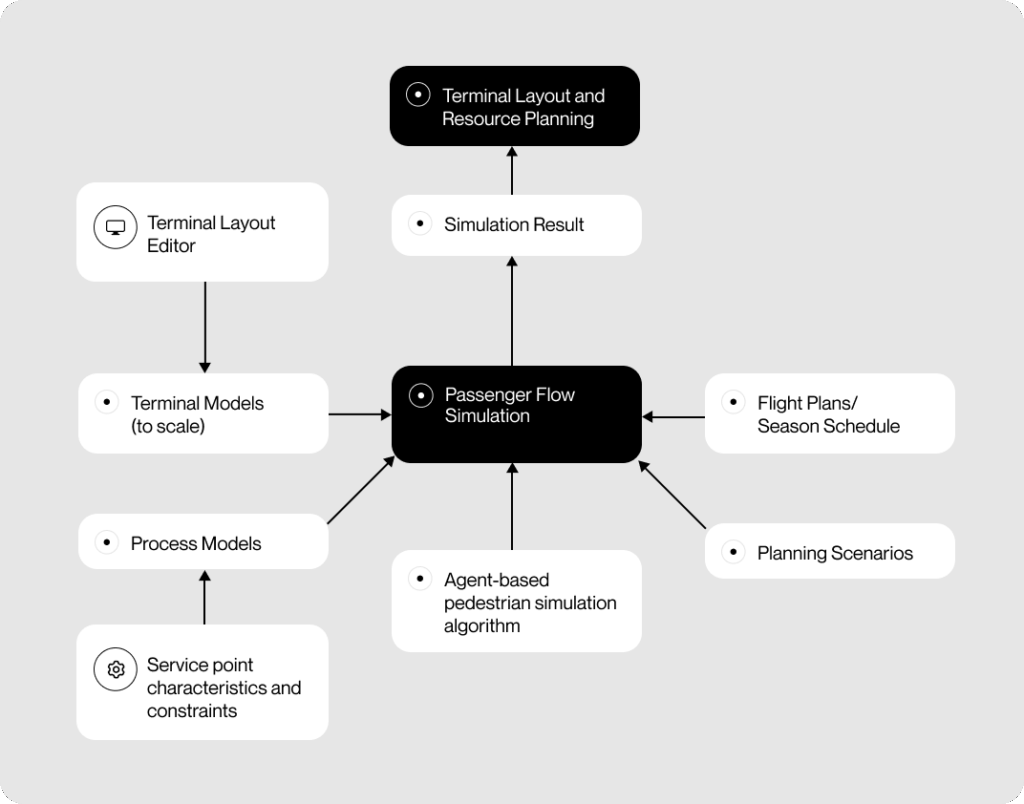
Simulate Passenger Flows and Compare Capacity Scenarios
AMORPH.aero Planning Studio enables airport teams to build terminal models and compare capacity scenarios using flight schedules, terminal layouts, and checkpoint parameters. The simulation follows passenger flows across routes and processing points, helping planners assess how a change in one area affects operations elsewhere.
For example, before temporarily closing a security checkpoint for construction, planners can model alternative passenger routes and assess the impact on the remaining checkpoints. Comparing these scenarios helps identify potential congestion and evaluate alternatives before changing the live terminal.
Models developed in Planning Studio can also be reused by other AMORPH.aero modules for terminal resource planning and passenger flow prediction, connecting capacity assessments with operational planning and forecasting.
Terminal Capacity Planning Features
- Layout-based terminal modeling: Create terminal models to scale, including passenger routes and travel distances.
- Flight schedule import: Use actual or forecast flight schedules to model passenger demand.
- Passenger flow simulation and visualization: Examine how passengers move through terminal areas and processing points.
- What-if scenario comparison: Evaluate alternative layouts, routes, and checkpoint configurations before making operational changes.
- Passenger density assessment: Assess crowding in terminal areas under different arrival and departure schedules.
Frequently Asked Questions About Airport Terminal Capacity Planning
Airport terminal capacity planning assesses whether terminal spaces and passenger processing points can accommodate expected demand. It considers passenger volumes, flight schedules, terminal layouts, and processing capacity to identify constraints and evaluate potential changes.
Passenger flow simulation models how passengers move through a terminal and its processing points. It helps planners compare scenarios and understand how changes to routes, layouts, or checkpoints may affect congestion and downstream processes before implementation.
Planning Studio uses terminal layouts, flight schedules, and checkpoint parameters to build passenger flow scenarios. Layout-based models represent routes and travel distances, while actual or forecast schedules provide the basis for assessing passenger demand.
Terminal capacity planning evaluates whether layouts and processing capacity can support expected passenger flows. Terminal resource planning focuses on the resources needed to handle that demand, such as staffing and lane requirements. AMORPH.aero allows models developed in Planning Studio to support subsequent resource planning and real-time operations management.