

Airport terminal operators continually face the challenge of operating efficiently, maintaining high levels of service, and managing costs effectively. To meet this challenge, resources must be planned and allocated based on dynamic demand, with special attention to avoiding over- or under-allocation of resources, which can result in unnecessary costs or compromised service levels. A key requirement is to ensure a positive customer experience.
The AMORPH.aero Terminal Operations Planning (TOP) module provides a platform for planning terminal operations and resources for the next period in an optimal manner. Resource requirements are based on the flight schedule for the applicable period, allocation rules, and any special events or expected variations in passenger loads. The resource planning output includes:
- Automatic allocation of the number of staff required at each service point based on simulation results
- Integrated staff ordering workflows (planned, ready, ordered) to manage collaborative activities (e.g. 3rd party supplier)
- Custom definition of rules for the number of staff per lane at all service points
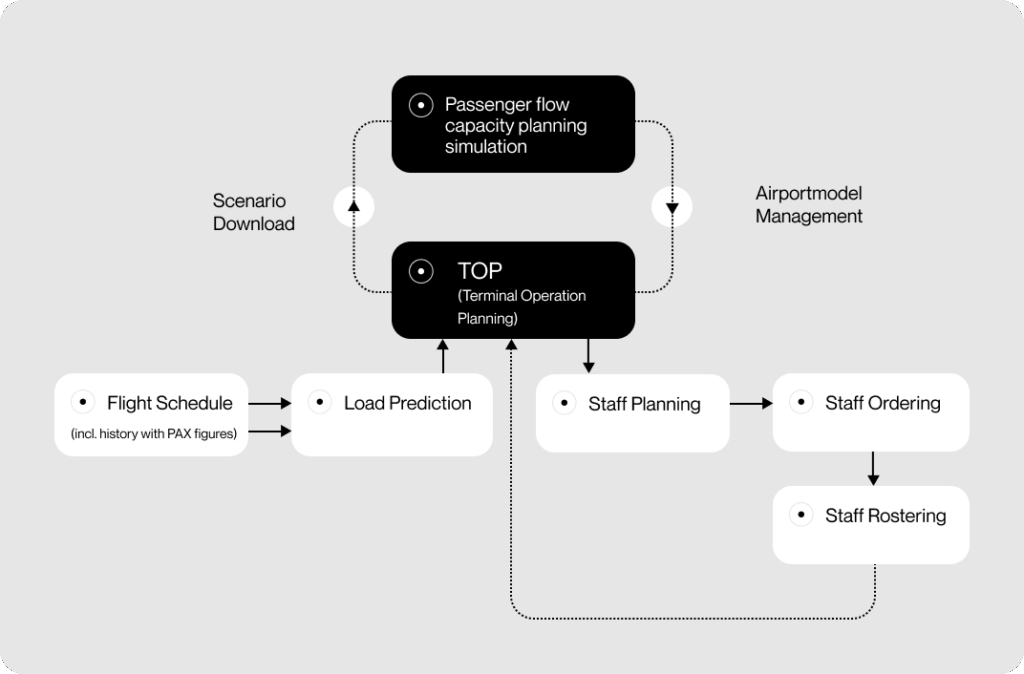
With the AMORPH.aero Terminal Operations Planning module resource plans can be shared with various stakeholders to facilitate coordinated planning and for use by staff in ordering and rostering systems.
In addition to predicting passenger loads, rules can also be defined to predict the load for baggage, car parking, and other resources that are related to the flight schedule.
The Terminal Operations Planning module can be scaled for planning resources in terminals ranging from large Hub airports to small regional airports. Users are empowered to perform all steps of planning, data analytics, and predictions with either simulation or static calculations for demand analysis and resource optimization.
Supported features include:
- Management of seasonal flight plans. Evaluate different passenger load scenarios to optimize resource allocation.
- Automatically extract load and transfer prediction rules from historical data. Incorporate historical passenger show-up data for more granular prediction rules.
- Support for special days and events. Simulate flows on unusual travel days for informed planning.
- Advanced profile predictions based on nationality, seasonality, leisure vs business travelers, time of day and day of week etc…Alignment with AODB or IATA format flight schedules to enable quick and easy importing of new flight schedules.
- Support for multiple and complex rule sets. Different rule sets can be applied for different conditions, such as weekday vs weekend, and severe weather conditions.
- Dynamic demand calculation with continuous simulation to incorporate changes in planning parameters as the day of operation approaches.
- Lane-based resource allocation. Planning based on the resources required per passenger processing lane.
- Budgetary forecasts. Costs per resource can be specified and indicative budgets generated for planned scenarios.
- Multiple scenario planning. Analyze and evaluate alternatives to continually refine and optimize planning.
- Ad-hoc evaluation of special constraints (e.g., staff shortages). Assess the impact of unusual constraints that occur in a dynamic environment.
