

Airports generate large amounts of operational data. Flight schedules, passenger demand, processing times, resource availability, and passenger flow measurements can all provide valuable information about how airport processes are performing.
For terminal operations, measurement technologies add another important layer of information. Passenger counting, queue measurement, and movement tracking can help airports understand what is happening across check-in, security, border control, and other passenger processes.
But there is an important limitation:
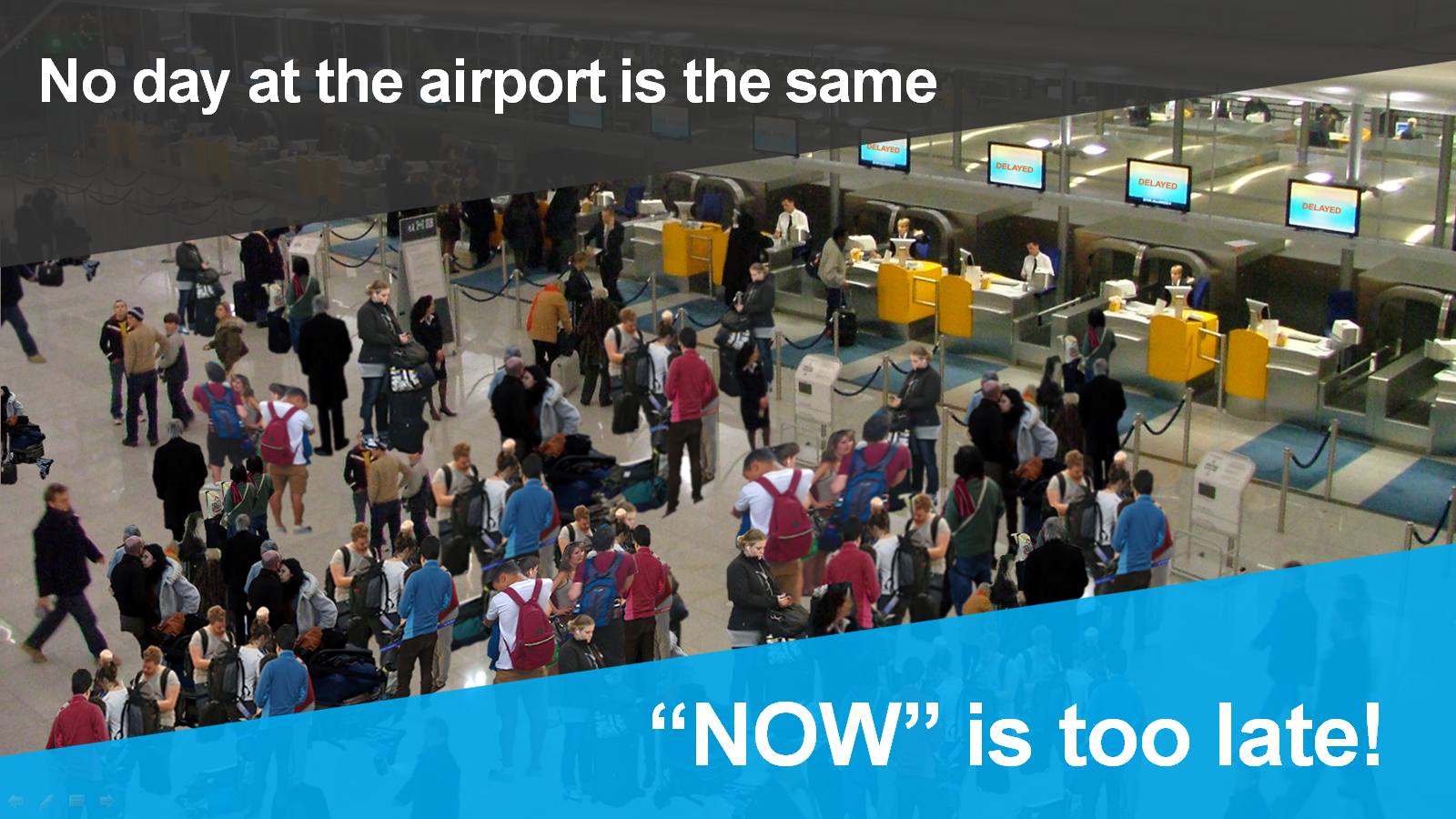
Measurement tells you what is happening now. Airport operations also need to understand what is likely to happen next.
By the time a growing queue or capacity constraint becomes visible in real-time data, the operational impact may already be developing. Additional resources may need to be prepared, processing capacity adjusted or stakeholders informed.
This is where airport passenger flow forecasting becomes important.
By combining operational data with passenger demand, process information and simulation, airports can estimate how passenger flows are expected to develop before they reach critical processing points.
Measurement and forecasting therefore serve different but complementary purposes: measurement provides visibility into actual conditions, while forecasting provides additional time to plan and prepare.
Passenger Flow Data Creates a More Complete Operational Picture
Passenger flow measurement provides valuable information about how travelers move through airport processes. Data such as passenger volumes, queue lengths, waiting times, throughput and occupancy can help airports understand how different terminal areas are performing.
The value increases when this information is combined with other operational data, such as flight schedules, expected passenger demand, processing capacity and available resources.
This creates a more complete picture of the relationship between passenger flows and airport operations. For planning teams, historical measurement data can also help identify recurring patterns, evaluate process performance and improve assumptions used for future planning and simulation.
Measurement data therefore provides more than a view of passenger movement. It creates an important data foundation for airport passenger flow analysis, planning and forecasting.
Measuring Passenger Process Performance
Passenger flow data also helps airports evaluate how efficiently terminal processes are performing.
Operational KPIs such as queue length, waiting time, dwell time, throughput and occupancy can provide insight into the performance of areas such as check-in, security, border control and other passenger processing points.
Tracking these indicators over time helps airports identify recurring bottlenecks, compare actual performance with planned conditions and understand how passenger demand affects available processing capacity.
This historical data can also support future planning by providing a stronger basis for capacity assessments, simulation and passenger flow forecasting.
Why Real-Time Measurement Alone Is Not Enough
Real-time passenger flow measurement gives airport teams valuable visibility into current conditions. It can show when queues are growing, waiting times are increasing or passenger volumes are changing across different processing areas.
But real-time data primarily describes what is happening now.
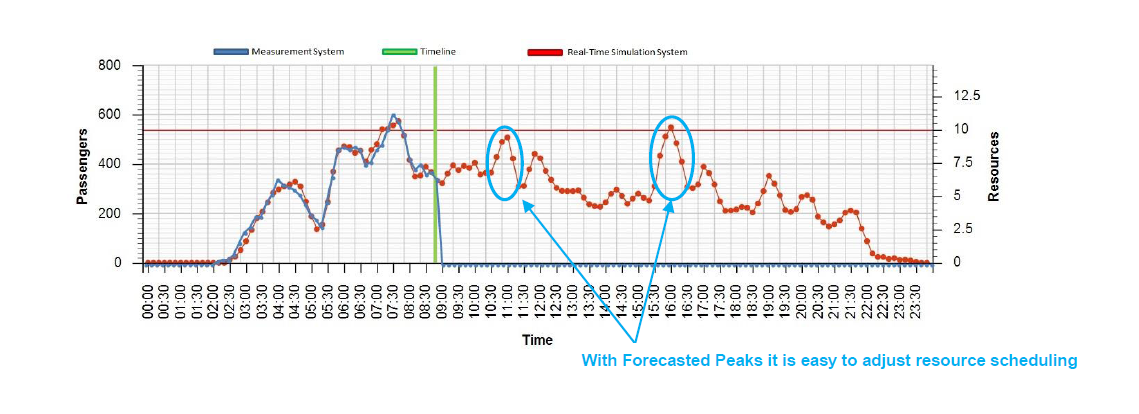
For airport operations, knowing that a queue has already formed is useful — but knowing that passenger demand is expected to increase before the queue develops provides more time to prepare.
This is where forecasting adds another dimension.
Airport passenger flow forecasting uses available operational data to estimate how passenger demand and processes are expected to develop over time. Depending on the available data and model, this can include expected passenger volumes, processing demand, queue development, waiting times and capacity requirements.
This forward-looking view can give airport teams additional time to review available capacity, prepare resources and coordinate with relevant operational stakeholders.
Measurement and forecasting therefore work best together:
Measurement shows how airport processes are actually performing.
Forecasting helps estimate how those processes are expected to develop.
Airports can then compare actual measurement data with forecast results, helping them evaluate forecast quality and continuously improve planning assumptions.
How AMORPH.aero Supports Passenger Flow Forecasting
AMORPH.aero combines operational data, passenger demand and simulation to support passenger flow forecasting and airport planning.
Agent-based simulation can model individual passenger movements and interactions with airport processes, helping airports understand how demand may develop across areas such as check-in, security, border control and other passenger processing points.
By incorporating relevant operational parameters and process characteristics, simulations can be used to evaluate expected passenger volumes, processing demand, waiting times and potential capacity constraints before they occur.
This allows airport teams to use forecasting for both planning and Day-of-Ops preparation, providing additional time to assess expected demand and prepare available capacity and resources.
Measurement data complements this process by providing actual operational results that can be compared with forecasts and used to continuously evaluate and refine planning assumptions.
Together, measurement, simulation, and forecasting provide airports with a stronger foundation for understanding passenger demand and managing terminal operations.
From Understanding the Present to Preparing for What Comes Next
Passenger flow measurement and forecasting solve different parts of the same operational challenge.
Measurement provides airports with reliable information about actual passenger flows and process performance. Forecasting extends that visibility by helping teams understand how demand and operational conditions are expected to develop.
Together, they give airport teams a stronger basis for planning capacity, preparing resources, and managing passenger processes throughout the operational day.
How Airport Passenger Flow Forecasting Works
Airport passenger flow forecasting combines relevant operational inputs with analytical or simulation models. Depending on the airport and use case, these inputs may include:
- Seasonal and daily flight schedules
- Live flight updates
- Expected passenger numbers
- Passenger arrival and behavior profiles
- Terminal layouts and walking routes
- Processing times and available capacity
- Current resource allocations
- Historical and real-time measurement data
AMORPH.aero uses agent-based simulation to model passenger movement through the terminal. Individual simulated passengers follow routes and interact with processing points based on the configured operational environment.
This makes it possible to evaluate how demand may develop across connected processes—not only at one isolated checkpoint.
From Measurement to Operational Action
A useful passenger flow process connects four stages:
1. Measure: Capture actual passenger volumes, queues, waiting times, occupancy and process performance.
2. Forecast: Use flight information, passenger demand, operational parameters, and simulation to estimate how conditions may develop.
3. Compare: Compare forecast conditions with live measurements. Differences can indicate that demand, passenger behavior, processing capacity or another operational assumption has changed.
4. Act: Use the combined information to review capacity, prepare resources, adjust allocations, or coordinate with operational stakeholders.
This creates a continuous feedback loop:
Measure → Forecast → Compare → Adapt
The purpose is not simply to produce another dashboard. It is to provide the time and operational context needed for better decisions.
Operational Applications
Combining measurement and forecasting can support several airport processes:
- Queue management: Anticipate increasing demand at check-in, security or border control.
- Resource preparation: Estimate when additional lanes, counters or staff may be required.
- Capacity planning: Evaluate whether existing terminal infrastructure can manage expected demand.
- Disruption preparation: Model how delays, checkpoint closures or changing passenger arrival patterns may affect connected processes.
- Performance improvement: Compare forecast and actual conditions to refine future planning assumptions.
For longer-term evaluation, airports can use terminal capacity planning to test layouts and demand scenarios. For daily preparation, terminal operation planning helps align resources with expected operational demand.
Measurement and Forecasting at Helsinki Airport
Helsinki Airport provides a practical example of this approach. Passenger flow simulation and queue-prediction capabilities were expanded to support both transfer passengers and local departing passengers.
The forecasts give airport stakeholders—and, in selected applications, passengers—a forward-looking view of expected waiting conditions. This demonstrates how forecasting can extend operational visibility beyond what is happening at the present moment.
FAQ About Airport Passenger Flow Forecasting
What is airport passenger flow forecasting?
Airport passenger flow forecasting estimates how passenger demand is expected to develop across terminal processes over time. It can help airports anticipate passenger volumes and processing demand at areas such as check-in, security and border control before operational conditions develop.
What is the difference between passenger flow measurement and forecasting?
Passenger flow measurement provides information about actual conditions, such as passenger volumes, queues, waiting times and occupancy. Forecasting uses available operational data and models to estimate how passenger demand and processes are expected to develop. Measurement explains what is happening, while forecasting provides a forward-looking view.
How can passenger flow forecasting help airport operations?
Passenger flow forecasting can give airport teams additional time to prepare for expected changes in demand. This can support capacity planning, resource preparation, passenger-process management and coordination between relevant operational stakeholders.
How is simulation used for airport passenger flow forecasting?
Simulation models how passengers move through airport processes based on factors such as expected demand, process characteristics and available capacity. Airports can use simulation to evaluate how passenger flows, waiting times and processing demand may develop under different operational conditions.
Why should airports combine real-time measurement with forecasting?
Real-time measurement provides actual information about current passenger flows and process performance, while forecasting provides an estimate of future conditions. Combining both allows airports to compare expected and actual performance and use that information to support planning and operational preparation.